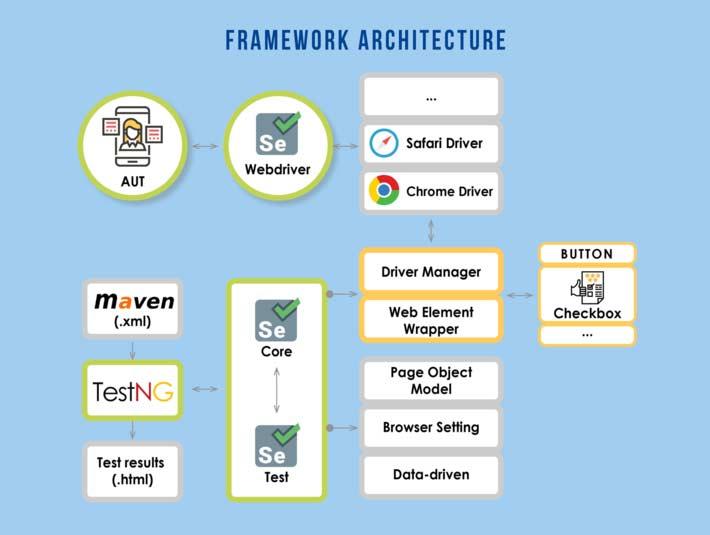
Selenium automation becomes more powerful when combined with a proper framework. A framework helps organize your test scripts, improve reusability, and make maintenance easier. For beginners, understanding Selenium frameworks is an important step toward real-world automation testing.
What is a Selenium Framework?
A Selenium framework is a structured way of writing and organizing automation test scripts. It includes guidelines, coding standards, libraries, and tools that help manage test execution efficiently.
Why Use a Framework?
Without a framework, your code can become messy and difficult to maintain. A framework helps:
- Reuse code
- Reduce duplication
- Improve readability
- Simplify debugging
Types of Selenium Frameworks
- Data-Driven Framework
- Keyword-Driven Framework
- Hybrid Framework
- Page Object Model (POM)
Real-Time Example (Login Automation)
Let’s understand with a simple real-time example:
Scenario:
Test a login page with multiple users.
Without Framework:
You write separate scripts for each user → repetitive code.
With Data-Driven Framework:
- Store user data in Excel or JSON
- Use one script to read data
- Run multiple test cases
With Page Object Model:
- Create separate class for login page
- Store all locators in one place
- Reuse methods like login()
Tools Used in Framework
- Selenium WebDriver
- TestNG
- Maven
- Excel/JSON
- Git
Benefits in Real Projects
- Easy to maintain large projects
- Faster execution
- Better team collaboration
- Scalable automation
Common Mistakes
- Not following structure
- Mixing test logic and locators
- Ignoring reusable methods
Final Thoughts
A Selenium framework is essential for real-time automation projects. Beginners should start with POM and gradually move to hybrid frameworks for better efficiency.