The demand for DevOps engineers has grown rapidly as organizations adopt cloud computing, automation, and continuous software delivery. Companies are looking for professionals who can streamline development processes, automate deployments, and ensure reliable application performance. If you're wondering how to become a DevOps engineer, this guide will help you understand the skills, tools, learning path, and career opportunities needed to succeed in this exciting field.
Whether you're a student, a software developer, a system administrator, or someone looking to switch careers, DevOps offers excellent opportunities for long-term professional growth.
What Does a DevOps Engineer Do?
A DevOps engineer bridges the gap between software development and IT operations. Instead of working in separate teams, DevOps engineers help developers, testers, and operations teams collaborate more effectively.
Their responsibilities include:
- Automating software deployments
- Managing cloud infrastructure
- Building CI/CD pipelines
- Monitoring applications
- Improving system reliability
- Configuring servers
- Managing containers and orchestration
- Troubleshooting deployment issues
The primary goal is to deliver software faster, more securely, and with fewer errors.
Why Choose a Career in DevOps?
DevOps has become one of the fastest-growing technology careers because organizations are moving toward automation and cloud-native development.
Some advantages of choosing DevOps include:
- High industry demand
- Competitive salaries
- Opportunities to work with modern technologies
- Continuous learning and career growth
- Roles available across startups and large enterprises
- Opportunities to work with cloud platforms
As businesses continue their digital transformation, DevOps professionals remain highly valuable.
Skills Required to Become a DevOps Engineer
Learning DevOps involves building both technical and problem-solving skills.
Linux Fundamentals
Linux is widely used for servers and cloud environments.
Learn topics such as:
- File system management
- User permissions
- Shell commands
- Package management
- Bash scripting
Strong Linux knowledge forms the foundation of DevOps.
Networking Basics
Understanding networking helps you troubleshoot applications and infrastructure.
Important concepts include:
- IP addressing
- DNS
- HTTP and HTTPS
- SSH
- Firewalls
- Load balancers
Networking knowledge is essential for cloud deployments.
Programming and Scripting
You don't need to become an expert software developer, but scripting skills are extremely valuable.
Recommended languages include:
- Python
- Bash
- Go
Python is especially popular for automation tasks.
Version Control
Every DevOps engineer should know Git.
Practice:
- Creating repositories
- Branching
- Merging
- Pull requests
- Resolving conflicts
Version control is used in almost every software project.
Cloud Computing Skills
Modern DevOps relies heavily on cloud platforms.
AWS is an excellent place to start because it is widely used across industries.
Important AWS services include:
- EC2
- S3
- IAM
- VPC
- CloudWatch
- Auto Scaling
Learning cloud fundamentals makes advanced DevOps concepts easier to understand.
Learn Containerization
Containers allow applications to run consistently across different environments.
Docker is the industry-standard tool for containerization.
Important Docker concepts include:
- Images
- Containers
- Dockerfiles
- Docker Compose
- Volumes
- Networks
Containerization is now a core DevOps skill.
Learn Kubernetes
Once you understand Docker, the next step is Kubernetes.
Kubernetes manages containers efficiently by providing:
- Automatic scaling
- Self-healing
- Load balancing
- Rolling updates
- Service discovery
Many organizations use Kubernetes in production environments.
Learn CI/CD
Continuous Integration and Continuous Deployment are key DevOps practices.
Popular CI/CD tools include:
- Jenkins
- GitHub Actions
- GitLab CI
- Azure DevOps Pipelines
These tools automate software builds, testing, and deployments.
Learn Infrastructure as Code
Infrastructure as Code allows cloud infrastructure to be managed using code.
Terraform is one of the most widely used IaC tools.
Benefits include:
- Faster infrastructure provisioning
- Version control
- Repeatable deployments
- Multi-cloud support
Learn Configuration Management
Configuration management tools automate server setup.
Popular choices include:
- Ansible
- Puppet
- Chef
Ansible is recommended for beginners because of its simple syntax.
Learn Monitoring Tools
Applications need continuous monitoring after deployment.
Popular monitoring tools include:
- Prometheus
- Grafana
- ELK Stack
Monitoring helps teams identify issues before users experience them.
Essential DevOps Tools
Every aspiring DevOps engineer should become familiar with:
- Git
- GitHub
- Jenkins
- Docker
- Kubernetes
- Terraform
- Ansible
- Maven
- AWS
- Prometheus
- Grafana
- Jira
Understanding how these tools work together is more important than simply memorizing commands.
Build Real-Time Projects
Hands-on experience is one of the best ways to prepare for DevOps roles.
Practice projects such as:
- Deploying applications on AWS
- Building a Jenkins CI/CD pipeline
- Creating Docker containers
- Deploying applications using Kubernetes
- Automating infrastructure with Terraform
- Configuring servers using Ansible
These projects improve your practical skills and strengthen your resume.
Certifications That Can Help
Although certifications are not mandatory, they can validate your knowledge.
Popular options include:
- AWS Certified Cloud Practitioner
- AWS Certified DevOps Engineer
- Docker Certified Associate
- Kubernetes certifications
- Terraform Associate
Combine certifications with practical experience for better career opportunities.
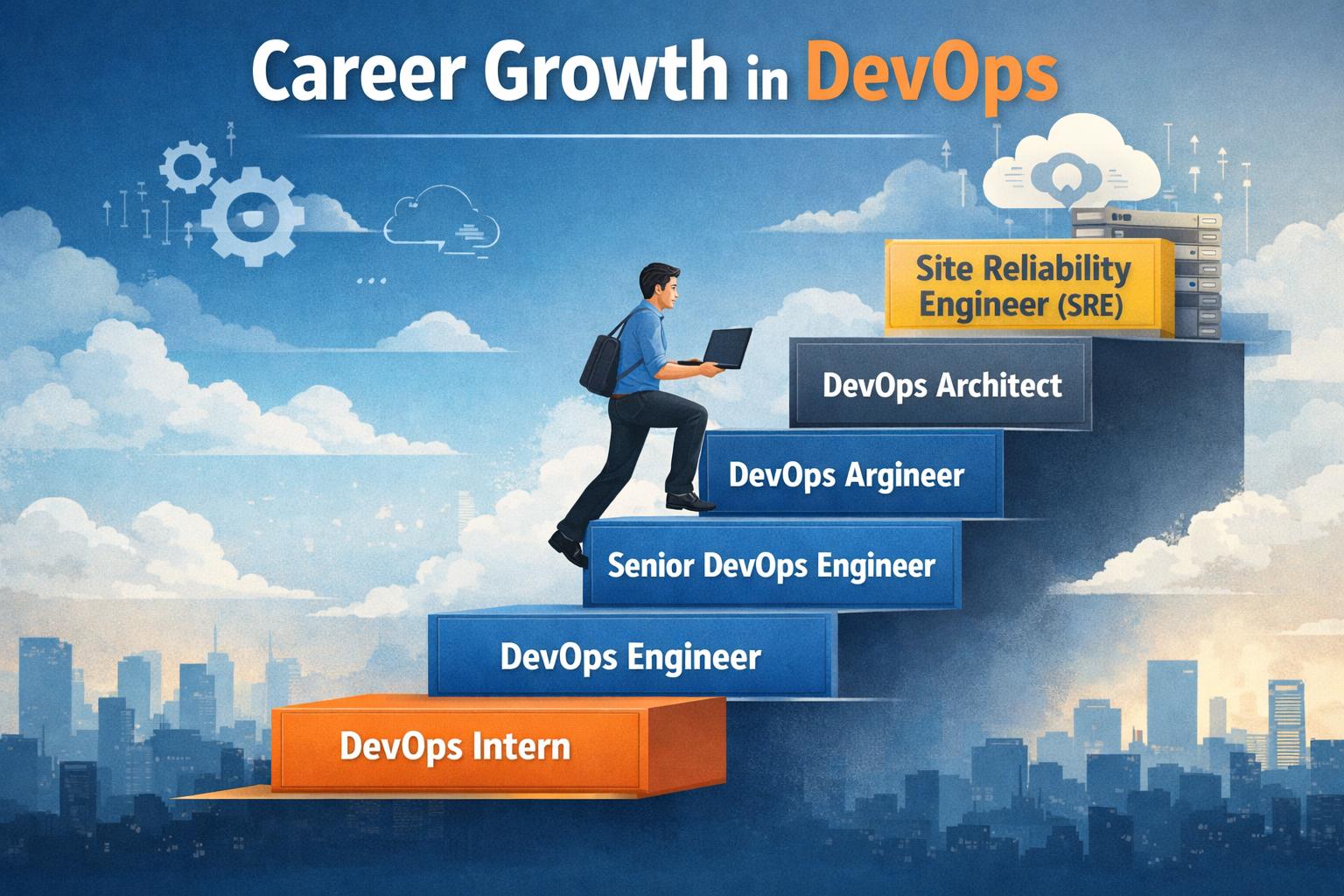
Career Path of a DevOps Engineer
A typical career progression may look like this:
- DevOps Intern
- Junior DevOps Engineer
- DevOps Engineer
- Senior DevOps Engineer
- Site Reliability Engineer (SRE)
- Cloud Engineer
- DevOps Architect
- Engineering Manager
With experience, professionals can specialize in cloud architecture, security, or platform engineering.
Tips for Beginners
To become a successful DevOps engineer:
- Learn one topic at a time.
- Practice every day.
- Build projects regularly.
- Use GitHub to showcase your work.
- Read official documentation.
- Join developer communities.
- Stay updated with new technologies.
Consistency and practical learning are more valuable than trying to learn everything at once.
Common Mistakes to Avoid
Many beginners make these mistakes:
- Skipping Linux fundamentals
- Ignoring networking concepts
- Learning tools without understanding DevOps principles
- Not working on projects
- Trying to master every tool immediately
Focus on building strong fundamentals before moving to advanced topics.
Final Thoughts
If you're wondering how to become a DevOps engineer, the answer is to build a strong foundation in Linux, networking, scripting, cloud computing, automation, and modern DevOps tools. Learning Git, Docker, Kubernetes, Jenkins, Terraform, and AWS step by step will prepare you for real-world projects and industry requirements.
DevOps is not just about tools—it is about improving collaboration, automating processes, and delivering reliable software efficiently. With regular practice, hands-on projects, and continuous learning, you can build a rewarding career in one of the fastest-growing fields in the IT industry.