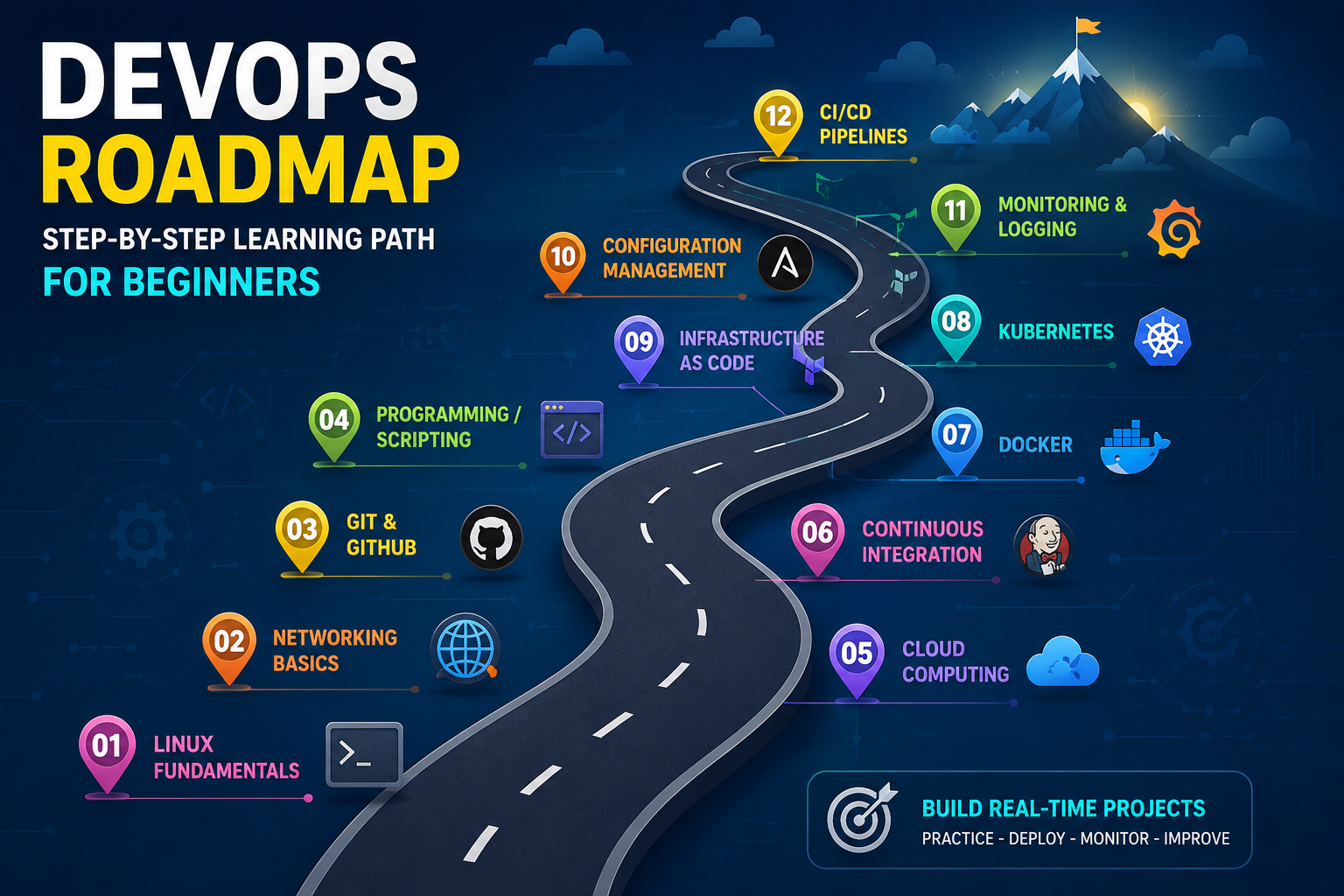
DevOps has become one of the fastest-growing career paths in the IT industry. Organizations are adopting DevOps practices to deliver software faster, improve collaboration, and automate repetitive tasks. As cloud computing and automation continue to grow, the demand for skilled DevOps professionals is increasing every year.
If you're planning to start a career in DevOps, following a structured learning roadmap will help you build the right skills without feeling overwhelmed. This guide explains a step-by-step DevOps roadmap for beginners in 2026, covering the essential technologies, tools, and concepts you should learn.
What is DevOps?
DevOps is a combination of Development (Dev) and Operations (Ops). It is a culture and set of practices that improve collaboration between software developers and IT operations teams.
The primary goals of DevOps are to:
- Deliver software faster
- Automate repetitive tasks
- Improve software quality
- Reduce deployment failures
- Enable continuous improvement
Instead of learning every tool at once, beginners should follow a structured learning path.
Step 1: Learn Linux Fundamentals
Linux is one of the most important skills for every DevOps engineer because most servers run on Linux.
Focus on learning:
- Linux file system
- Basic terminal commands
- File permissions
- User management
- Process management
- Shell scripting basics
Spend time practicing commands daily to become comfortable working in the terminal.
Step 2: Understand Networking Basics
Every DevOps professional should understand how networks work.
Learn topics such as:
- IP Address
- DNS
- HTTP and HTTPS
- SSH
- Ports
- Firewalls
- Load Balancers
A good understanding of networking helps troubleshoot deployment and infrastructure issues.
Step 3: Learn Git and GitHub
Version control is a fundamental DevOps skill.
Git helps developers track code changes, while GitHub allows teams to collaborate efficiently.
Practice:
- Git init
- Clone repositories
- Commit changes
- Branching
- Merge
- Pull Requests
Almost every DevOps project uses Git.
Step 4: Learn a Programming or Scripting Language
You don't need to become a software developer, but basic programming knowledge is very useful.
Good choices include:
- Python
- Bash
- Go
Python is highly recommended because it is easy to learn and widely used for automation.
Step 5: Learn Cloud Computing
Cloud platforms are a core part of modern DevOps.
Start with AWS because it is widely used across industries.
Learn services like:
- EC2
- S3
- IAM
- VPC
- CloudWatch
- Auto Scaling
Understanding cloud infrastructure is essential before moving to advanced DevOps tools.
Step 6: Learn Continuous Integration (CI)
Continuous Integration allows developers to merge code frequently while automatically testing every change.
Popular CI tools include:
- Jenkins
- GitHub Actions
- GitLab CI
Practice creating automated build pipelines.
Step 7: Learn Docker
Docker simplifies application deployment by packaging applications and their dependencies into containers.
Topics to learn:
- Images
- Containers
- Dockerfile
- Docker Compose
- Volumes
- Networks
Docker has become a standard tool in modern DevOps environments.
Step 8: Learn Kubernetes
After Docker, learn Kubernetes for container orchestration.
Important concepts include:
- Pods
- Deployments
- Services
- Namespaces
- ConfigMaps
- Secrets
Kubernetes helps manage and scale containerized applications efficiently.
Step 9: Learn Infrastructure as Code (IaC)
Infrastructure as Code automates infrastructure provisioning.
Popular tools include:
- Terraform
- AWS CloudFormation
Terraform is widely used because it supports multiple cloud providers.
Step 10: Learn Configuration Management
Configuration management tools automate server configuration.
Popular tools:
- Ansible
- Puppet
- Chef
Ansible is beginner-friendly and commonly used in DevOps projects.
Step 11: Learn Monitoring and Logging
Applications must be monitored continuously after deployment.
Popular monitoring tools:
- Prometheus
- Grafana
- ELK Stack
Monitoring helps detect issues before they affect users.
Step 12: Learn CI/CD Pipelines
Once you've learned individual tools, combine them into a complete CI/CD pipeline.
A simple workflow includes:
- Git repository
- Jenkins build
- Docker image creation
- Kubernetes deployment
- Monitoring
Understanding how these tools work together is one of the most valuable DevOps skills.
Build Real-Time Projects
Theory alone is not enough.
Practice projects like:
- Deploy a web application on AWS
- Create a Jenkins pipeline
- Containerize an application using Docker
- Deploy containers using Kubernetes
- Automate infrastructure using Terraform
Real-world projects improve confidence and strengthen your resume.
Common Mistakes Beginners Make
Avoid these common mistakes:
- Learning too many tools simultaneously
- Ignoring Linux fundamentals
- Memorizing commands without practice
- Avoiding cloud platforms
- Not building projects
- Skipping Git
Learning step by step is much more effective than trying to master everything quickly.
Career Opportunities After Learning DevOps
Once you complete this roadmap, you can apply for roles such as:
- DevOps Engineer
- Cloud Engineer
- Site Reliability Engineer (SRE)
- Build and Release Engineer
- Platform Engineer
- Infrastructure Engineer
As your experience grows, you can specialize in cloud architecture, Kubernetes administration, or DevSecOps.
Tips to Learn DevOps Faster
- Practice every day.
- Build small automation projects.
- Learn one tool at a time.
- Upload projects to GitHub.
- Read official documentation.
- Join DevOps communities.
- Follow industry blogs and YouTube channels.
- Stay updated with cloud technologies.
Consistency is more valuable than trying to learn everything in a short period.
Final Thoughts
Learning DevOps may seem challenging because it covers multiple technologies, but following a structured roadmap makes the process much easier. Start with Linux, networking, Git, and programming basics before moving to cloud computing, Docker, Kubernetes, CI/CD, and Infrastructure as Code.
Remember that DevOps is not just about learning tools. It is about understanding automation, collaboration, and continuous improvement. By practicing regularly and working on real-world projects, you can build the skills needed to become a successful DevOps professional.
The demand for DevOps engineers continues to grow across industries, making it one of the best career choices for aspiring IT professionals. Following this roadmap in 2026 will help you build a strong foundation and prepare for exciting opportunities in cloud computing and software automation.